
Bouse-Town Construction Guide: From One Mattress to the Estate
by Bouse-Town Team8 min read
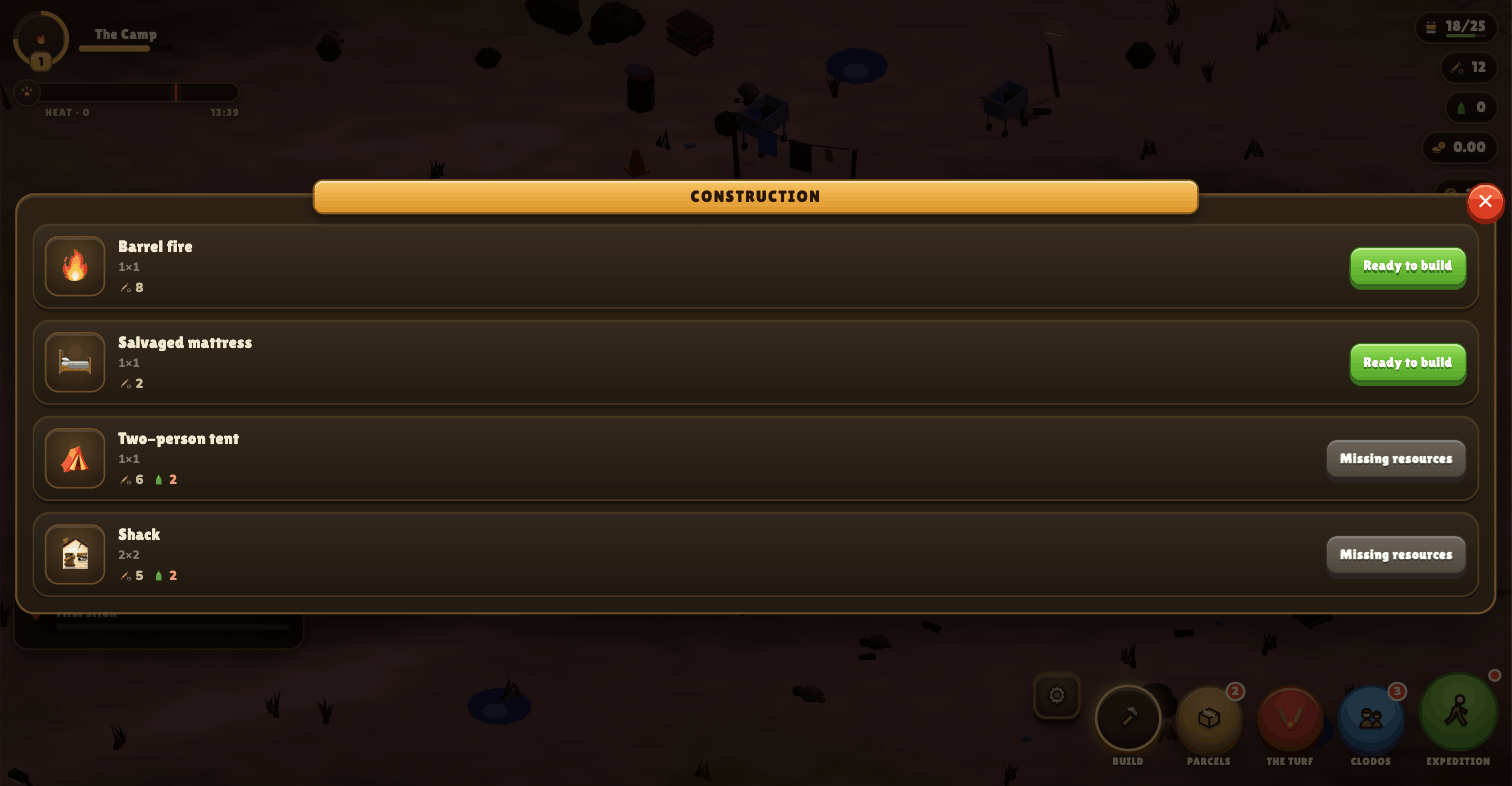
Bouse-Town construction currently starts with a two-scrap mattress and expands through tents, shacks, a barrel fire, a barricade and a food reserve. Use the table below to compare the current costs and passive effects before you spend camp resources.
Town dispatch, filed from the good sofa.
Bouse-Town lets the player build and upgrade a camp. The ledger below mirrors the current buildings.json content pack rather than a design note or remembered play session. When the source changes, this article must change with it. To compare construction costs with the timers, heat and returns that can fund them, use the Bouse-Town expedition guide.
The ladder, bottom rung first
Three resources pay for the structures below: scrap, deposits, and, for the final shack stage, dirty money.
| Structure | Stage | Cost | What you get |
|---|---|---|---|
| Salvaged mattress | 1 | 2 scrap | 1 bed |
| Salvaged mattress | 2 | 6 scrap + 2 deposits | 2 beds |
| Two-person tent | 1 | 6 scrap + 2 deposits | 2 beds |
| Two-person tent | 2 | 12 scrap + 5 deposits | 3 beds, +1 morale |
| Shack (2×2) | 1 | 5 scrap + 2 deposits | 2 beds, +1 morale |
| Shack (2×2) | 2 | 10 scrap + 6 deposits | 4 beds, +1 morale |
| Shack (2×2) | 3 | 18 scrap + 10 deposits + 5 € | 5 beds, +2 morale |
| Barrel fire | 1 | 8 scrap | +1 morale |
| Barrel fire | 2 | 12 scrap + 4 deposits | +2 morale |
| Barrel fire | 3 | 20 scrap + 10 deposits | +3 morale, 1 bed |
| Pallet barricade | 1→3 | 8 → 14 → 22 scrap (+ deposits) | 90 → 180 → 300 defense |
| Food reserve (2×1) | 1 | 10 scrap + 4 deposits | 30 meals of storage |
| Food reserve (2×1) | 2 | 16 scrap + 8 deposits | 70 meals, +1 morale |
A few lines in that table deserve commentary, and one deserves a lawyer.
How we verified this construction ledger
On July 22, 2026, we checked every row against the current building definitions used by the project. We copied four fields only:
- the structure name and stage;
- the resource cost for that exact stage;
- the listed passive effect;
- the footprint when it changes how much camp space the structure uses.
We did not use a design document, an old screenshot, or a planned feature. We also removed an earlier narrative claim when the current event data did not support it. This method makes the table a snapshot of the current content pack, not a promise that future balance versions will keep the same numbers.
Two scrap. One bed. One king.
The mattress opens with the smallest listed build cost and adds one bed. Its second stage adds another bed and introduces deposits to the cost.
The shack is the whole game in one building
Shack stage one costs 5 scrap and 2 deposits, while the first tent stage costs 6 scrap and 2 deposits. The shack occupies a larger footprint and its later stages demand more resources. The final stage is the only current building stage whose source cost includes dirty money.
That progression makes the shack cheap to start and expensive to finish without inventing a hidden fee or event.
The trade-off appears before the final stage. You can open the shack route with fewer scrap than the first tent stage, but later upgrades ask for more deposits and eventually dirty money. Compare the next stage you can actually afford; do not compare only the finished buildings.
The barrel fire, barricade and food reserve solve different problems
The barrel fire spends scrap to raise morale, then adds a bed at its third stage. The pallet barricade spends progressively more scrap and deposits on defense. The food reserve expands meal storage and adds morale at its second stage.
Use those differences to diagnose the camp instead of following one universal build order:
- If bed capacity blocks you, compare the mattress, tent and shack stages.
- If morale limits your plan, compare the tent upgrade, shack stages and barrel fire.
- If defense concerns you, inspect the barricade stages and the resources they postpone elsewhere.
- If meal storage constrains longer plans, compare both food-reserve stages.
However, a passive effect does not prove that one structure dominates every situation. Your current stock and next expedition still decide which cost matters most.
What the ledger does not prove
The current source does not contain the previously described bailiff letter or its fee. That scene came from unsupported copy, so this revision removes it instead of turning it into an official game mechanic.
The content pack proves costs, footprints, unlock levels, and passive effects. It does not prove a narrative consequence unless an event also exists in the event pack. Future dispatches must keep that boundary visible.
Guidance from the planning department
There is no planning department. Read the table as a comparison tool:
- Check the next stage you can build, not the final stage you want later.
- Identify the resource that blocks that stage.
- Compare the passive effect with the problem in your camp.
- Check whether an expedition can supply the missing resource.
- Keep enough resources for the decision that follows the build.
The source supports those comparisons; it does not support a universal build order. For the current timers, heat and loot ranges behind step four, read the complete Bouse-Town expeditions board.
Quick construction questions
What is the cheapest current Bouse-Town structure?
The first salvaged-mattress stage costs 2 scrap and adds one bed. Compare that entry cost with the later upgrade before treating it as the cheapest long-term route.
Which current construction stage uses dirty money?
The third shack stage lists 18 scrap, 10 deposits and 5 € of dirty money. No other current building stage in this ledger lists dirty money.
Does this guide provide a best build order?
No. It gives you verified costs and effects so you can choose against your current constraint. A single build order would ignore your available resources, camp state and next expedition.
The estate won't be legal. It will be yours.
Filed by the Bouse-Town Team. Approved by nobody — we have the stamp to prove it.