
Satirical City Builder Strategy: Read the Consequences Before You Click
by Bouse-Town Team8 min read
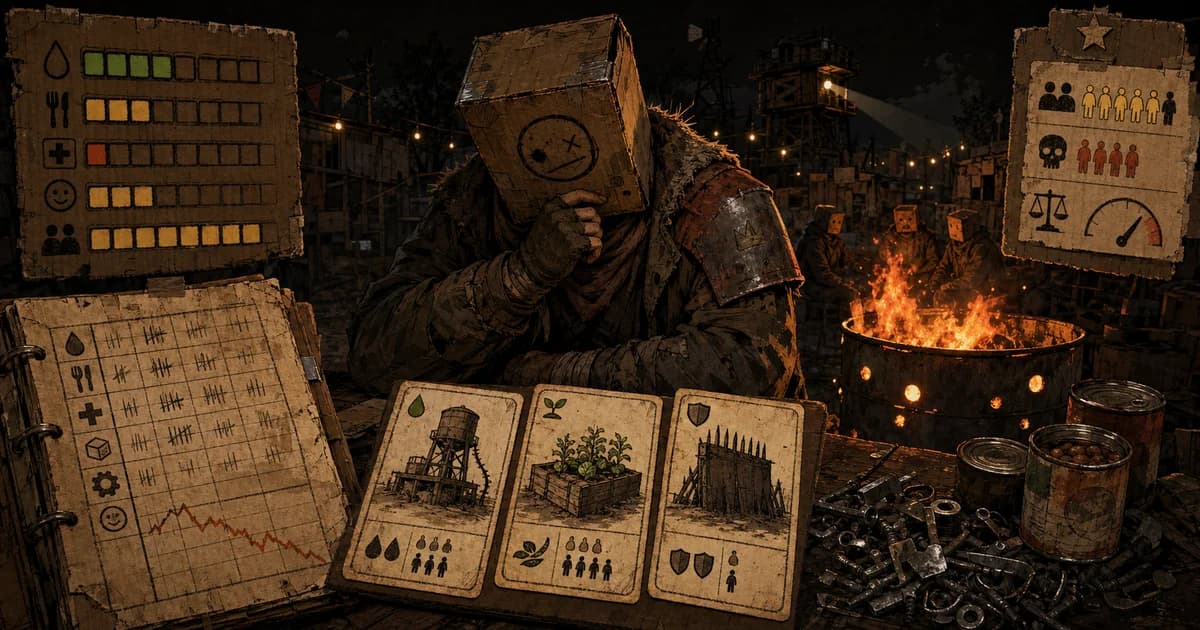
A satirical city builder still runs on serious decisions. Before you choose an event response in Bouse-Town, identify the resource at risk, check what your camp needs next, compare the visible consequences, and keep enough capacity to recover from a bad result.
The joke belongs in the writing. Your strategy belongs in the ledger.
Read the camp before the event
An event choice does not happen in isolation. The same option can look cheap in one camp and reckless in another.
Pause and check four things:
- Which resource currently limits your next build or upgrade?
- Does the camp need beds, morale, defense, or food storage first?
- What did the last expedition change?
- Which loss would take the longest to recover?
This order matters because a resource total has no meaning without a job. Ten scrap can be spare material or the exact amount holding your next structure together.
Use the Bouse-Town construction guide when you need the current building costs and effects in one place. Use the expedition guide when you need to compare the routes that feed the camp.
Translate every choice into a trade-off
Choice-driven satire often tempts you to select the funniest line. Read the mechanical decision underneath it first.
For each option, write a quick translation:
| What the card suggests | What you should ask |
|---|---|
| Gain a resource now | What future cost or risk comes with it? |
| Protect the group | Which opportunity do I give up? |
| Take a risky shortcut | Can the camp survive the worst visible result? |
| Spend to avoid trouble | Does that spend block a more urgent upgrade? |
| Choose the absurd answer | Am I choosing chaos deliberately or overlooking the consequence? |
You do not need to remove the humor. You need to know when the humor is buying a story and when it is quietly selling the food reserve.
Use a recovery budget
Do not spend every resource simply because a build button becomes available. Keep a recovery budget for the next expedition and event.
A practical reserve has three parts:
- enough flexible material to respond to one immediate problem;
- enough food or capacity to avoid a forced emergency decision;
- one upgrade path you can delay without breaking the camp.
The exact reserve changes with your state. Bouse-Town does not need one universal number because the bottleneck changes as the camp grows.
Ask a stronger question than “Can I afford this?”
If I pay this cost now, which next problem becomes expensive?
That question turns a purchase into a sequence.
Compare immediate value with camp shape
Some structures add capacity. Others improve morale, defense, or storage. Those effects solve different problems, so a single value ranking will mislead you.
Use a two-column decision:
Immediate effect:
What changes as soon as I choose this?

Camp shape:
Which future options become easier or harder?
A bed can unlock room for another person. Morale can support a stressed camp. Defense can protect what you already built. Storage can keep a future food gain from becoming waste. Compare the job, not only the price.
Treat the seed as consistency, not prophecy
Bouse-Town uses seeded random streams so the same saved state resolves consistently. That supports a stable game state. It does not mean you should pretend to know every future event from one outcome.
Use the consistency for review:
- note the state before a decision;
- record what you chose;
- identify the visible consequence;
- decide whether the mistake came from missing information or accepting a risk.
Do not call every bad result random. If the card showed the risk and your reserve could not absorb it, the strategic mistake happened before the result.
Separate role-play from optimization
You can play for survival, construction efficiency, maximum chaos, or a specific camp story. Name the run before you judge it.
An optimized run may avoid a choice that creates the funniest consequence. A role-play run may accept it because the story is the point. Both approaches work when you choose them deliberately.
Use one of these run rules:
- Camp-first: choose the option that protects the current bottleneck.
- Builder: prioritize the next structure and preserve its resource path.
- Story-first: accept the consequence that best fits the camp you are playing.
- Chaos with a floor: choose the absurd option only while a recovery reserve remains.
The last rule lets you enjoy the satire without turning every click into the same self-inflicted collapse.
Run a ten-second decision check
Before the final click, ask:
- What does this choice cost now?
- What can it cost next?
- Which camp need does it serve?
- Can I recover if the visible risk lands?
- Am I choosing this for strategy, story, or the joke?
If you can answer all five, click with confidence. If you cannot, reopen the ledger.
Bouse-Town is a satirical camp-management game for web and iOS. It lets you build and upgrade a camp, then presents choice-driven satirical events after expeditions. The satire gets louder when you understand exactly which terrible decision you made.